
RAG or fine-tuning: pick by the problem.
Use RAG when the model lacks knowledge: your documents, fresh data, anything that changes. Use fine-tuning when the model lacks behaviour: a style, a format, a narrow task it keeps getting slightly wrong. Many products need both, a tuned model inside a RAG pipeline. Start with RAG; it is cheaper to change.
- RAG
- Knowledge, freshness, citations
- Fine-tuning
- Style, format, a narrow task
- Prompting
- Steers both; try it first
- I built
- RAG.NextUpgrad and FineTune Studio

- 5production AI apps
- 14engineers led
- 200+students mentored
Questions students ask
The comparison students search for most, answered from building both.
RAG vs fine tuning
They solve different problems. RAG, retrieval-augmented generation, fetches relevant passages from your documents at answer time and lets the model read them, so the model gains knowledge it never had. Fine-tuning continues training the model on examples, so the model gains behaviour: tone, output format, domain vocabulary, a task it should do consistently. A knowledge problem is a RAG problem; a behaviour problem is a fine-tuning problem.
When to use RAG vs fine tuning
- Facts that change, long documents, answers that must cite a source: RAG.
- Private or customer-specific data you cannot bake into weights: RAG.
- A consistent voice, strict JSON output, classification at scale, a narrow domain where the base model stumbles: fine-tuning.
- Latency and cost pressure on a repetitive task: a small fine-tuned model often beats a large prompted one.
- Both at once is common: a fine-tuned model that answers from retrieved passages.
Which is better RAG or fine tuning?
Neither is better in general. In the same year I built RAG.NextUpgrad, a retrieval platform with hybrid search and a confidence gate, and FineTune Studio, a QLoRA fine-tuning platform. The first exists because customers asked questions about documents that changed weekly; the second exists because some tasks needed a model to behave a particular way every time. If I can only pick one for a new product, I start with RAG, because it is cheaper to iterate and the failure modes are visible.
RAG vs fine tuning difference
Where the knowledge lives: in RAG it stays in your documents and is looked up; in fine-tuning it is pressed into the weights. How you update it: RAG updates by adding a file; fine-tuning updates by training again. What you can show the user: RAG can cite the passage; a fine-tuned model cannot show where a fact came from. What it costs: RAG costs tokens per query; fine-tuning costs GPU time up front and cheaper queries after.
Data requirements differ too. RAG needs documents, which you already have, plus a question set to measure against. Fine-tuning needs hundreds to thousands of input-output examples in the exact shape you want, which usually means writing or cleaning them by hand; poor examples produce a confidently wrong model. Latency differs: RAG adds a retrieval round-trip and a longer prompt, while a fine-tuned small model can be faster than a large prompted one. Failure modes differ: a RAG system fails visibly when retrieval misses, which you can measure, while a fine-tuned model fails quietly when a request drifts away from its training distribution. Keep these in mind when a stakeholder asks for 'training the AI on our data'; nine times in ten they are describing RAG.
Prompting vs RAG vs fine tuning
Prompting is the first lever and the cheapest: instructions, examples and structure in the prompt. Try it before either of the others. When the prompt cannot carry the knowledge (too much of it, or it changes), add RAG. When the prompt cannot reliably produce the behaviour (format drifts, tone slips, the task is subtle), fine-tune. In practice the order of investigation is prompt, then RAG, then fine-tune, and most products stop at RAG.
RAG vs fine tuning vs embedding
Embeddings are not a third option; they are a component of RAG. An embedding model turns text into vectors so that similar meanings land close together, which is how retrieval finds the right passages. You can also fine-tune an embedding model on your own query-passage pairs, which improves retrieval for a specialised domain without touching the language model at all. That is often the highest-value fine-tune in a RAG system.
RAG vs fine tuning vs LoRA
LoRA is a way of fine-tuning, not an alternative to it. Instead of updating every weight, LoRA trains small adapter matrices alongside the frozen model, which cuts memory and lets the adapter be swapped per task. QLoRA goes further by quantising the frozen model to 4-bit, which is how FineTune Studio trains on modest GPUs. So the comparison is RAG versus fine-tuning; LoRA is simply how most fine-tuning is done today.
MCP vs RAG vs fine tuning
MCP, the Model Context Protocol, is a way for a model to call tools and read resources from external systems in a standard format. It is neither retrieval nor training; it is plumbing for agents. A RAG system can be exposed to a model as an MCP tool (search my documents), and a fine-tuned model can be the one calling MCP tools. Think of MCP as how the model reaches things, RAG as what it reads, and fine-tuning as how it behaves.
RAG vs fine tuning examples
- Support assistant over a product manual that changes every release: RAG, with citations.
- Extracting invoice fields into a fixed JSON schema at high volume: a fine-tuned small model, validated against the schema.
- A tutor that must answer from the course notes but in a particular encouraging style: RAG for the notes, a light fine-tune for the voice.
- Classifying tickets into twelve categories: fine-tuning a small model beats prompting a large one on cost and consistency.
Is RAG or fine tuning better?
Ask two questions. Does the model fail because it does not know something? Then RAG. Does it fail because it knows but does it wrong, inconsistently or verbosely? Then fine-tune. If the answer is both, build the RAG pipeline first, measure what remains wrong on a real question set, and fine-tune only for that remainder. That order keeps the expensive, slow step small.
A decision in five minutes
The order I use with clients.
- 01
Write ten failing examples
Real inputs where the current model disappoints. Mark each one: wrong fact, or wrong behaviour.
- 02
Fix the prompt first
Instructions, two or three examples, a strict output format. Re-run the ten.
- 03
Add retrieval for the facts
If what remains is missing knowledge, build RAG with citations and a test set.
- 04
Fine-tune the remainder
If what remains is behaviour, collect a few hundred examples and run a LoRA fine-tune; compare base and tuned on the same prompts before shipping.
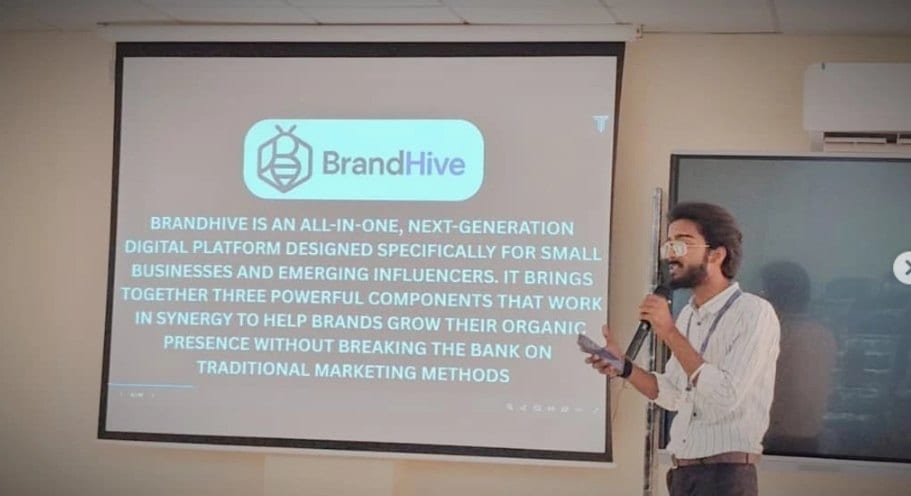
In the room
Where these systems get explained to students.

Read next
Both sides of the choice in depth.
Not sure which one you need?
Bring the failing examples; twenty minutes is enough to tell.