
A tech talk is one idea, shown, from your own work.
A tech talk explains something technical to people who want to use it: a tool, a method, a lesson from a project. The good ones teach one idea with a live demo and honest failures, in the speaker's own voice. Confidence comes from preparation and repetition, not personality. I have given more than twenty sessions to students and I speak at colleges for free.
- A tech talk
- One idea, a demo, what failed, what to do next
- Confidence
- Preparation, rehearsal, repetition
- Start
- A ten-minute talk at your own club
- I have given
- 20+ sessions; colleges invite me through this site

- 20+campus sessions
- 200+students mentored
- 500+community members
Questions students ask
The tech talk and public speaking questions searched most, answered from the stage.
What is tech talk?
A tech talk is a presentation on a technical subject to a technical audience: a tool, a technique, an architecture, a project and what it taught. It runs from ten-minute lightning talks at meetups to hour-long conference sessions, and it differs from a lecture in being practical and from a pitch in being honest about trade-offs. The audience wants to leave able to do something new or to avoid a mistake. The best tech talks show real code, real demos and real failures, and they come from the speaker's own experience rather than from a summary of documentation.
What does tech talk mean?
Literally, talking about technology; in practice, a recognised format in engineering culture: companies run internal tech talks where engineers share what they built, communities and conferences run them as sessions, and colleges invite speakers to give them. The phrase implies a peer talking to peers, with substance over polish. It is also used loosely for any technology-themed speech, including school events and marketing presentations, and for product names and summits, which is why search results are mixed. For a student, giving a tech talk means standing in front of a club or class and teaching something you have done.
Tech talk examples
- How I built a document assistant with retrieval and citations, and where it failed: architecture, live demo, numbers, lessons.
- Running language models on a laptop: Ollama, quantisation, what fits, what it is good for; demo on stage.
- Fine-tuning on a free GPU: the dataset, the run, the before-and-after comparison.
- Face recognition in the browser without uploading a frame: the privacy design and the code.
- What judging a hackathon taught me about pitching: with examples from both sides.
- From BCA to GenAI engineer: the three projects that made the difference. Each of these is a talk I have given or offer; the talks page lists the current set.
What is tech talk topics?
The best topic is the thing you did most recently that other people are trying to do. Patterns that work for students: a project walkthrough with failures; a tool you adopted and how it changed your workflow; a comparison you ran with numbers; a mistake and how you recovered; a beginner's guide to something you learned the hard way. Avoid topics you only read about; the audience can tell. Scope to one idea per talk: not 'AI', but 'how to make a chatbot cite its sources'. If you can state the one thing the audience will be able to do afterwards, you have a topic.
TED talk vs tech talk
A TED-style talk is a polished, general-audience story about an idea, rehearsed to the second, with emotion and no code. A tech talk is a practical session for people who will use what you show, with code, demos and trade-offs, and a question period where the real learning often happens. Borrow from TED the discipline of one idea and a clear arc; keep from the tech talk the substance and the honesty. Students who try to make every talk a TED talk end up with slides full of inspiration and no demo; students who make every talk a code dump lose the room by minute five. The balance is a story about real work with a demo in the middle.
What is public speaking?
Public speaking is communicating to a group in person or on a call: presentations, talks, pitches, teaching, moderating, answering questions. It is a skill like coding, learned by doing with feedback, and it matters for engineers more than they expect: explaining a design to a team, demoing to users, pitching at a hackathon, interviewing, and later leading. Fear of it is normal and does not go away; it becomes manageable. The specific skills are structure (what you say in what order), delivery (voice, pace, eye contact, pauses) and handling the room (questions, time, technical failures).
How to build confidence in public speaking
Confidence follows competence and repetition. Prepare so well that you could give the talk without slides: know the first two minutes word for word, know the structure, know the demo cold. Rehearse aloud, standing, timed, at least three times, once to a person. Speak in low-stakes rooms first: your club, a class, a community meetup, a recorded video for yourself. Expect nerves and plan for them: breathe before you start, slow down, pause instead of filling. Collect small successes; the tenth talk is a different experience from the first. Every confident speaker you have seen was once terrified and simply did it again.
How to build public speaking skills
- Structure every talk the same way until it is automatic: hook, the one idea, demo or evidence, what failed, what to do next, close.
- Record yourself and watch once; note fillers, pace and where the structure sags.
- Practise the opening and the close most; the middle takes care of itself.
- Learn to pause; silence feels long to you and natural to the audience.
- Ask for one piece of feedback after each talk and act on it next time.
- Volunteer for short slots often: lightning talks, demo days, club sessions, teaching juniors.
- Watch good speakers in your field and copy one technique at a time.
How to learn public speaking at home
Talk to a camera. Pick a topic you know, prepare a five-minute explanation with a simple structure, record it on your phone, watch it, and record it again with one improvement. Explain your projects aloud as if to a friend, then to an imagined sceptic. Read aloud to practise pace and clarity. Join online communities that run lightning talks and demo days, where you can speak from your desk to a small audience. Teach someone one thing on a call each week. Then take it into a room: a club meeting is the next step, and the camera practice makes the room easier than you expect.
How much do college speakers get paid?
It varies from nothing to substantial fees: professional keynote speakers charge; most industry guests at college events speak for free or for travel, as a contribution to the community and for the visibility; student speakers are almost never paid. I speak at colleges for free, and the carousel on why explains the reasoning: the students are the point, the invitations build a network, and the talks sharpen the work. If you are a college inviting a speaker, be clear about what you can cover, usually travel and hospitality, and about the audience and the outcome you want; the guide on inviting a guest speaker and the invite page on this site cover how to ask.
Your first tech talk in two weeks
From a project to a ten-minute session at your club.
- 01
Pick the one idea
Something you did recently that others are trying to do; state what they will be able to do afterwards.
- 02
Build around the demo
Six slides: hook, idea, demo, what failed, what to do next, close. The demo works offline.
- 03
Rehearse three times
Standing, timed, once to a person; the opening word for word.
- 04
Give it and ask
Deliver at your club; ask for one piece of feedback; book the next one.
On stage
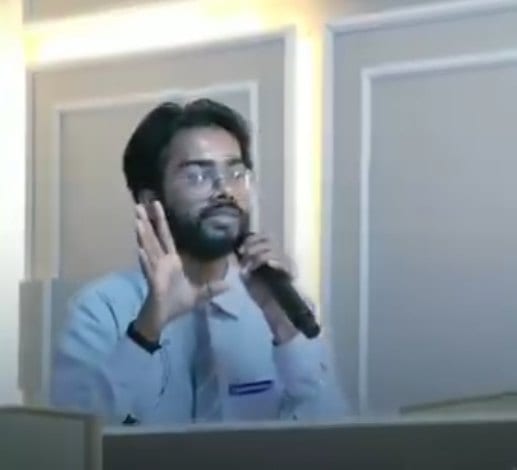
A few of the sessions.

Read next
Speaking, inviting and the talks I give.
Want a speaker who shows real work to your students?
I give talks and hands-on sessions on building with AI, at colleges, for free.