
Judges reward what works, explained clearly.
Hackathons are won by teams that pick a sharp problem with a real user, build the smallest demo that convincingly solves it, show the technical depth honestly, and pitch it in two minutes that anyone can follow. Not by the most ambitious idea, the most features or the most slides. I won three first prizes with that approach and have scored more than ten events against it since.
- Wins
- Problem fit, working demo, depth, clarity
- Loses
- Scope creep, broken demos, pitches about features
- AI tools
- Allowed almost everywhere; judged on what you understand
- I have
- Three first prizes; 10+ events judged

- 3first prizes
- 10+hackathons judged
- 200+students mentored
Questions students ask
The winning questions searched most, answered from the judging table.
How to win a hackathon
- Choose a problem with a user you can name and a pain you can describe in one sentence; judges score problem fit first.
- Scope to the smallest demo that proves the solution end to end; cut everything else by hour two.
- Make the demo work on stage: real input, real output, a backup video in case of network failure.
- Show one piece of real technical depth: a model doing real work, a clever data path, a measured result.
- Pitch in two minutes: problem, user, demo, how it works, what you measured, what is next, team. Rehearse three times.
- Be honest about limits; judges trust teams that know what their demo does not do.
- Talk to mentors and judges during the event; they remember teams that listened.
Best hackathon tips
Decide the demo script before you write code, and build towards that script. Integrate early: a working ugly path by the midpoint beats three polished parts that do not connect. Use boring technology you already know for everything except the one thing you are showing off. Prepare demo data that makes the point obvious. Assign one person to the pitch and the video from the start, not at the end. Sleep a little; judgement at hour thirty is poor. Submit before the deadline with margin. And watch the winning teams at every event you attend; what they do is more instructive than any list, including this one.
How to win hackathon using AI
Use AI tools to build faster and use AI in the product only where it removes real friction. For building: coding agents scaffold, write boilerplate and fix errors, which lets a small team finish; read what they produce, because a demo that breaks because nobody understood the code is the commonest failure. For the product: a model should do work the user actually needs, grounded in real data, with a visible check on its output; a chatbot pasted onto a form earns nothing. Judges at AI events ask whether the model is necessary, whether outputs are checked and what happens when it is wrong. Have answers.
How to win AI hackathon
Pick a narrow problem where a model obviously helps: documents that must be read, questions that must be answered from a specific source, images that must be checked, speech that must be captured. Ground the model in real data from the problem domain and show citations or evidence on screen; judges at AI hackathons are weary of ungrounded demos. Measure something, even roughly: accuracy on twenty examples, time saved on a task. Handle failure visibly: a decline path, a confidence indicator, a human check. Keep the interface plain. The teams I have scored highest did one AI thing properly and could explain exactly how it failed.
How to win Smart India Hackathon
Smart India Hackathon is judged by the organisations that wrote the problem statements, so read the statement like a client brief and solve what they asked, not what you would prefer to build. Understand the domain: who uses the solution, in what conditions, with what constraints such as low connectivity or regional languages. Build a working prototype that addresses the core of the statement with realistic data, and present it in the evaluators' terms: impact, feasibility, deployment. Team composition matters across the long timeline; six members with distinct roles and a mentor who knows the domain. The Smart India Hackathon guide on my answers site covers each stage from internal selection to finale.
How to win hackathon without coding
Teams win with non-coding members all the time, because a hackathon is not only code. Someone must own the problem research and the user story, the design and interface, the demo data, the pitch and the video, and the coordination that keeps the team on scope; those are the parts that most often lose otherwise strong technical teams. No-code and low-code tools, visual automation builders and AI app generators also let a non-programmer produce a working prototype for many problem types. Join a team that needs those skills, take them seriously, and the trophy counts for everyone on the team.
How to win a hackathon solo
Solo entries win when the scope is tiny and the execution is complete. Choose a problem whose smallest demo you can build alone in the time, using a stack you know and AI coding tools to cover the ground a team would. Spend proportionally more time on the demo and pitch, because you have no one to delegate them to; record the demo video early. Lean on mentors for the feedback a teammate would give. Many events require teams, so check the rules, and consider whether a team of two with a complementary partner found at the event would double your odds; it usually does.
Is it easy to win hackathon?
No, and it is more predictable than it looks. Most teams eliminate themselves: they pick a problem too large, never integrate, arrive at the demo with a broken build, or pitch a list of features instead of a story. A team that avoids those mistakes is in the top quarter before judging starts. Winning from there depends on the field, the judges and some luck, which is why experienced competitors enter many events and expect to win a few. Treat each one as practice in finishing and pitching, and the wins arrive as a by-product.
What do hackathon winners get?
Prizes vary: cash, gadgets, cloud and model credits, internships or interviews with sponsors, incubation and mentoring, and at national events the chance to pilot the solution with the organisation that set the problem. The durable rewards are the ones nobody hands over: a finished project with a demo, teammates who proved themselves under pressure, mentors and judges who remember you, and a credible line on the résumé that interviewers ask about. Several of the opportunities in my own career traced back to people who saw a demo at an event, not to the prize money.
How to put hackathon win on resume
List it under projects or achievements with the event name, the date, the placing and the scale ('first place among forty teams'), followed by one line on what you built and what it did, the technologies, your role, and a link to the code or demo. Lead with the project, not the trophy, so the reader sees capability. If the project continued afterwards, say so with numbers. In interviews, be ready to walk through the decisions, the failures during the event and what you would change; a hackathon story told well demonstrates scoping, teamwork and shipping in two minutes, which is exactly what interviewers are listening for.
The two-minute pitch
The structure that scores, slide by slide.
- 01
Problem and user
One sentence each; a real person and a real pain.
- 02
Demo
Live, with real input; the backup video ready.
- 03
How it works and what you measured
One diagram; one honest number; one limitation.
- 04
What is next and the team
The next step if it continued; who did what.
At the table
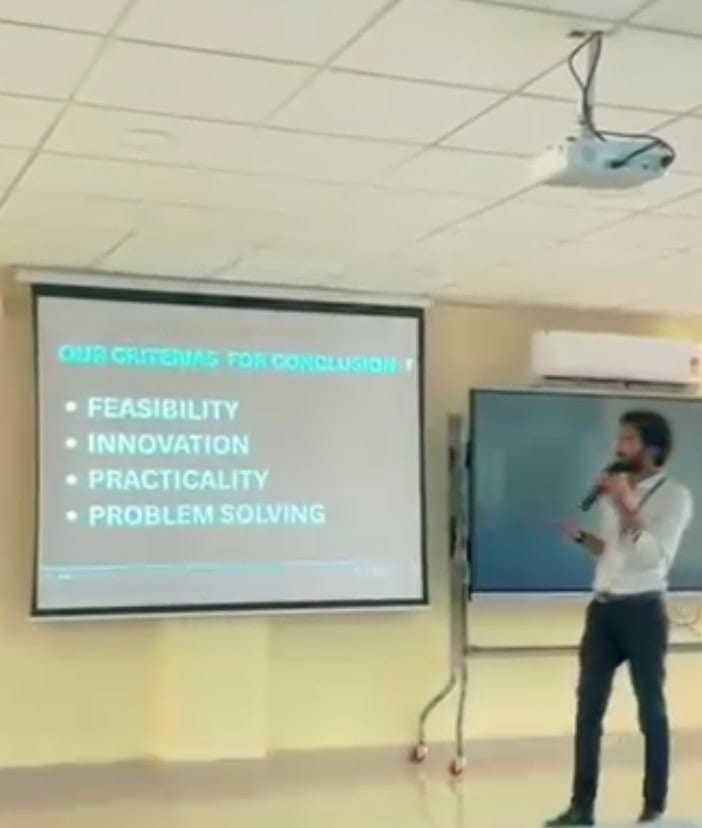
Judging, mentoring and the odd trophy.

Read next
Ideas, pitching and the judging view.
Want your teams to finish and pitch well?
I run pre-hackathon sessions on scoping and pitching, and I judge with written feedback for every team.