
A hackathon is a weekend that teaches you to ship.
A hackathon is an event, usually twenty-four to forty-eight hours, where small teams build a working software or hardware project around a theme or problem statement and present it to judges. It is part competition, part crash course in scoping, building and pitching under pressure. I won three first prizes as a student and have judged more than ten since; the format rewards the same things every time.
- Format
- Teams, a theme, a time box, a demo, judges
- Rewards
- A working demo, a real problem, a clear pitch
- Gives you
- A project, teammates, mentors, sometimes prizes
- I have
- Three first prizes; 10+ events judged

- 3first prizes
- 10+hackathons judged
- 200+students mentored
Questions students ask
The hackathon questions searched most, answered from both sides of the judging table.
What is a hackathon?
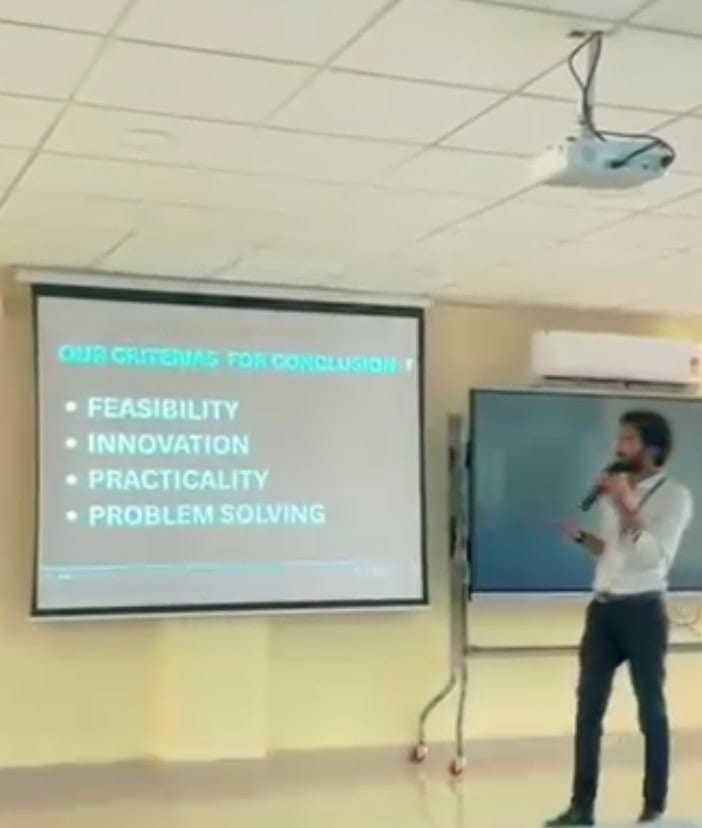
A hackathon brings together developers, designers and domain people to build something in a fixed, short time. Organisers announce a theme or specific problem statements, teams of two to five form, and from the opening to the final demo the teams design, code and test a project, with mentors circulating and food appearing at odd hours. At the end each team presents for a few minutes to judges who score on criteria such as problem fit, technical quality, completeness, design and presentation. Prizes range from cash and gadgets to internships, incubation and cloud credits, but most participants come away with something more durable: a shipped project and a team.
How does a hackathon work?
- Registration: solo or as a team; many events match solo participants into teams at the start.
- Kick-off: theme and problem statements announced, rules and judging criteria explained, mentors introduced.
- Build: the time box, often overnight; teams scope, divide work, build, integrate and test.
- Check-ins: mentors visit; some events have mid-way reviews that cut the field.
- Submission: code, a short write-up and sometimes a video, by the deadline.
- Demo and pitch: a few minutes per team, with questions from judges.
- Judging and awards: scores against a rubric; winners announced; networking after.
What is hackathon and how does it work?
Think of it as a compressed product cycle. In the first hour you choose a problem and decide what the smallest convincing version looks like. In the next several hours you build that version, each person on a part: backend, interface, data or model, pitch. Around the halfway mark you integrate and discover what breaks. In the final hours you fix, polish the demo and rehearse the pitch. Judges then see a few minutes of your work and decide. The compression is the point: it forces decisions that a semester project lets you postpone, and it teaches scoping better than any lecture.
What is hackathon for beginners?
For a beginner, a hackathon is the fastest way to learn what building actually involves, and you do not need to be good yet. Join a team with people who have done one; take a defined role, such as the interface, the data, or the pitch and the demo video; and finish your part. Most events welcome beginners explicitly and have mentors for exactly this. You will learn more in one weekend about Git, APIs, integration and presenting than in a month of tutorials. The guide on participating in your first hackathon covers what to bring, how to find a team and what to expect hour by hour.
What is hackathon in college?
College hackathons are run by student clubs, departments or the college with sponsors, open to students of that college or several, usually over a day or a weekend on campus, with themes tied to the sponsor's interests or social problems. They are the easiest first hackathon: familiar surroundings, friends as teammates, faculty and alumni as mentors and judges. Winning one earns recognition on campus and a line on the résumé; participating earns a project and a team. Many colleges also run selection rounds for national events such as Smart India Hackathon, where the problem statements come from ministries and industry.
How Smart India Hackathon works
Smart India Hackathon is a national programme in which ministries, government bodies and companies publish problem statements, student teams from colleges across India propose solutions, colleges run internal selection rounds, and shortlisted teams compete in the grand finale over several days at nodal centres, building and presenting to evaluators from the problem-statement owners. Teams are typically six members with a mentor, the software and hardware editions run separately, and winning teams receive cash prizes and sometimes the chance to deploy their solution. The timeline runs months from registration to finale. The Smart India Hackathon guide on my answers site covers the selection, the team composition and what evaluators look for.
What is hackathon and how to prepare for it
- Form a team of complementary skills before the event; agree roles.
- Set up tooling in advance: repository, deployment target, a starter template for your stack, API keys for any models you will use.
- Read the theme and draft two or three problem ideas, each with a user you can name.
- Practise a two-minute pitch structure: problem, user, demo, how it works, what is next.
- Pack for the time box: chargers, water, snacks, a plan for sleep.
- Decide in advance to cut scope ruthlessly; the demo that works beats the idea that would have been great.
What is hackathon projects?
Hackathon projects are the things teams build during the event: small, focused applications that solve one problem convincingly. Good ones share a shape: a clear user, one core feature that works end to end, a simple interface, and something that shows the technical depth, such as a model doing real work on real data. In AI hackathons the common winning shapes are a grounded assistant over a specific document set, an extraction tool for a painful form, a vision tool that runs in the browser, or an automation with a confirmation step. The project lives on afterwards as a portfolio entry if you write it up and keep the demo running.
What does AI hackathon mean?
An AI hackathon is one whose theme or problem statements centre on AI: building with language models, vision, speech or agents, often with sponsors providing model credits and judges from AI companies. The judging adds criteria specific to AI: whether the model actually does something the demo needs, whether outputs are grounded and checked, whether the team understands the failure modes, and whether the system would work beyond the demo data. Teams that bolt a chatbot onto a form do poorly; teams that pick a real problem where a model removes real friction, and show it working with honest limits, do well. My judging rubric is public.
What is hackathon all about?
Underneath the prizes and the pizza, a hackathon is about learning to finish. Most students have started many projects and shipped few; the time box, the team and the demo deadline make finishing unavoidable. It is also about people: the teammates you find, the mentors who remember you, the sponsors who notice a working demo. And it is about taste: seeing what wins teaches you what a good problem, a tight scope and a clear pitch look like. Go to several, lose some, win one, and you will have a portfolio, a network and judgement that no course provides.
Your first hackathon, hour by hour
The plan I give beginners.
- 01
Hour 0 to 2
Pick the problem and the user; define the smallest demo; assign roles; set up the repo and deploy target.
- 02
Hour 2 to 12
Build the core path end to end, ugly but working; integrate early.
- 03
Hour 12 to 20
Fix what broke; make the interface clear; prepare demo data that shows the point.
- 04
Final hours
Freeze features; rehearse the pitch three times; record a backup demo video.
At the table
Judging, mentoring and the odd trophy.

Read next
Winning, ideas and judging.
Organising a hackathon and want a judge who gives feedback?
I judge with a public rubric and write notes for every team, and I brief judging panels before finals.