
Generative AI, explained by someone who ships it.
Generative AI is software that produces new content, text, images, code, audio, video, by learning the patterns in enormous amounts of existing content and sampling from them. Large language models are its best-known form. Agentic AI is what you get when such a model is given tools and a goal. I build both, and I teach students how to get from curiosity to a shipped project.
- Produces
- Text, images, code, audio, video
- Core models
- LLMs, diffusion models, multimodal models
- Agentic AI
- A generative model with tools and a goal
- I built
- Five AI apps; taught 200+ students

- 5production AI apps
- 14engineers led
- 200+students mentored
Questions students ask
The generative AI questions searched most, answered plainly.
What is generative AI?
Generative AI refers to models that create new content rather than only classifying or predicting a label. A language model writes a paragraph that never existed; an image model draws a picture from a description; a code model completes a function; a speech model produces a voice. They do this by learning a statistical model of their training data, billions of sentences or images, and then generating new samples that follow the same patterns. The outputs are original in the sense that they are not copies, and derivative in the sense that everything in them was learned from existing work.
How does generative AI work?
Text models predict the next token: given the words so far, output a probability for every possible next piece of text, pick one, append it, repeat. Trained on enough text, that simple objective produces models that can answer questions, write code and follow instructions, after a further stage that tunes them to be helpful. Image models work differently: diffusion models learn to remove noise from images step by step, so starting from random noise and denoising towards a text description produces a new picture. Both are large neural networks trained with gradient descent on huge datasets, and both are steered at use time by the prompt you give them.
What is generative AI examples?
- Chat assistants that answer, summarise, translate and draft (ChatGPT, Claude, Gemini, Copilot).
- Code assistants that complete and refactor code inside editors.
- Image generators that produce pictures from text (Midjourney, Stable Diffusion, the image modes of major assistants).
- Document assistants that answer from your own files with citations, such as RAG.NextUpgrad, the platform I built.
- Extraction systems that turn invoices and contracts into structured data, such as DocuLens AI.
- Speech systems that transcribe and synthesise voices.
- Video and music generation, the newest and least mature category.
Generative AI vs agentic AI
Generative AI produces content in response to a prompt: you ask, it answers, the interaction ends. Agentic AI uses a generative model as the decision-maker in a loop: it is given a goal and tools (search, code execution, APIs, files), decides which action to take, observes the result, and continues until the goal is met or it gives up. The model is the same kind of thing; what changes is the system around it: tool definitions, memory, limits, verification. Most products today are generative with a few agentic features, and the engineering challenge in agentic systems is reliability and evaluation rather than the model itself.
Why generative AI is important
Because it changes what one person can produce. Writing, coding, designing, analysing documents and learning new material all get a capable assistant that works at the speed of conversation. For students that means a tutor available at midnight and a pair programmer for every project; for small teams it means shipping products that previously needed a specialist for each part. It also matters because it is the first AI that non-technical people use directly, which makes understanding its limits, especially fabricated facts, a basic literacy. The economic and research effects are large and still being measured; the practical effect on how a developer works is already here.
Why generative AI is bad
The honest criticisms are specific. Models produce confident falsehoods, which misleads people who trust them; the fix is grounding and verification, which many products skip. Training data was taken from the web without the consent of its authors, and the legal and ethical questions are unresolved. Generated text and images flood the web and make real information harder to find. Energy and water use for training and serving is significant. Jobs built on routine writing, illustration and support are changing fast. And over-reliance can stop students from learning fundamentals. None of this is a reason not to learn the technology; it is a reason to build it responsibly, which is what the citations, gates and validation across my projects are for.
How to learn generative AI
- Python first, to the point of being comfortable with functions, data structures and APIs.
- Use the tools daily: a chat assistant and a code assistant, noticing where they fail.
- One course on how language models work (tokens, attention, training, fine-tuning), without getting stuck in theory.
- Build a RAG app over your own notes: chunking, embeddings, retrieval, citations. This single project teaches most of the practical field.
- Fine-tune a small model once on a free GPU so you understand what training changes.
- Ship something public with a write-up; a portfolio beats certificates. The free guides on my answers site walk through each step.
What is generative AI engineer?
A generative AI engineer builds products on top of generative models: choosing and calling models, designing prompts and tool interfaces, building retrieval pipelines, fine-tuning when needed, evaluating outputs, and deploying it all as reliable software with monitoring and cost control. The role sits between software engineering and machine learning: closer to the product than a researcher, closer to the model than a web developer. The daily work is less about training models and more about retrieval quality, evaluation sets, latency, cost, and making the system fail safely. My own path ran from a BCA degree to this role through building and shipping, which I describe on this site.
How to become generative AI engineer
Learn to build before you learn to theorise. Get solid at Python and at building and deploying a web service. Build three real projects in increasing depth: a document assistant with retrieval and citations, an extraction pipeline with validation, and a fine-tuned small model with an honest before-and-after evaluation. Publish them with code and write-ups. Learn evaluation as a first-class skill, because teams hire people who can prove a system works. Contribute to a community or speak at a college event; explaining the work sharpens it. Then apply with the portfolio, not the certificate list. The guides on becoming an AI engineer and on getting an AI internship cover the specifics.
What is prompt engineering in generative AI?
Prompt engineering is designing the input to a generative model so that it reliably produces the output you need: clear instructions, the right context, examples of the desired format, constraints on what to avoid, and structure the model can follow. It is the first lever in any generative system and the cheapest to change. It is not magic words; it is specification writing. In production it extends to system prompts that set behaviour, templates that insert retrieved context, structured output schemas, and prompt evaluation on a test set, because a prompt that works on three examples can fail on the fourth. Good prompts are versioned and tested like code.
Your first year in GenAI
The roadmap I give first-year students.
- 01
Foundations
Python, Git, one web framework, and daily use of AI tools with a critical eye.
- 02
One real project
A RAG assistant over your own notes with citations and a test set.
- 03
Go deeper
Fine-tune a small model; build an extraction pipeline; deploy both.
- 04
Be visible
Write it up, present it, join or start a campus community.
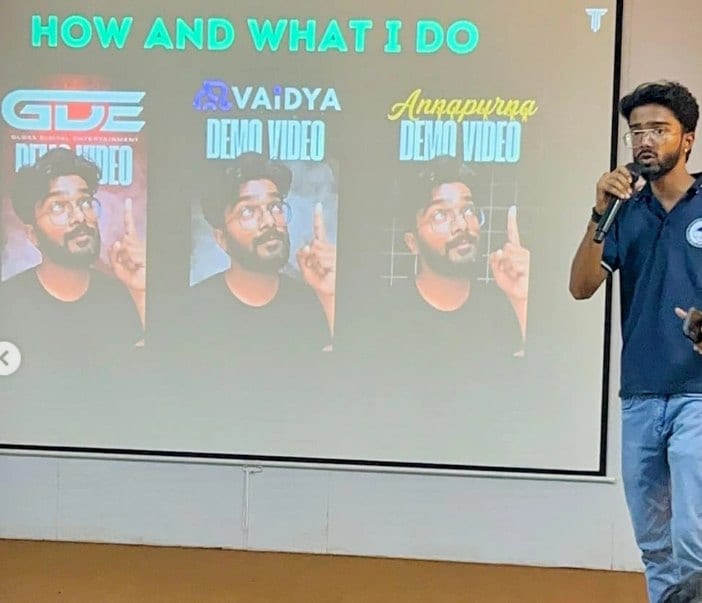
In the room
Where these systems get explained to students.

Read next
The path and the parts.
Want to go from curious to shipped?
I mentor students and teams through their first real GenAI project, with the same standards I use in production.