
Agentic AI: models that act, not only answer.
Agentic AI describes systems in which a language model decides and acts over multiple steps towards a goal, using tools, observing results and adapting, instead of producing one reply. Generative AI is the engine; agentic AI is the car built around it. It is powerful for multi-step work and fragile without limits, verification and evaluation, which is where the engineering lives.
- Generative
- Prompt in, content out, once
- Agentic
- Goal in, actions and checks until done
- Needs
- Tools, memory, limits, verification
- I built
- Agents and the MCP server they call

- 5production AI apps
- 14engineers led
- 200+students mentored
Questions students ask
The agentic AI questions searched most, answered from building agentic systems.
What is agentic AI?
Agentic AI is the use of AI models, usually large language models, as autonomous decision-makers inside software: given an objective, the model plans steps, calls tools, reads what came back, revises its plan and continues until the objective is met, it is blocked, or a limit is reached. The word agentic points to agency, the capacity to act. A generative model alone has none; it waits for a prompt and returns text. Wrap it in a loop with tools and a goal and it gains the ability to do things in the world, which is both the promise and the risk.
What is agentic AI in simple words?
A chatbot answers a question. An agent does a job. Ask a chatbot how to book a meeting and it tells you the steps. Ask an agent and it checks your calendar, finds a slot, drafts the invite, and asks you to confirm before sending. Under the hood it is the same kind of model; the difference is that the agent is allowed to use tools and to take several turns on its own. Think of it as the model being handed a to-do list and a set of keys, with rules about which doors it may open without asking.
What is agentic AI and how it works
- A goal and context are given to the model along with descriptions of the tools it may use.
- The model reasons about the next action and emits a tool call with arguments.
- The application runs the tool and returns the result to the model.
- The model updates its plan, calls another tool or finishes with a result.
- Memory keeps what has been learned within the task and, optionally, across tasks.
- Guardrails bound it: step caps, budgets, allowed tools, confirmation for consequential actions.
- A verifier checks the result against the goal before it counts, and logs make every run inspectable.
What are agentic AI examples?
Coding agents that take an issue, edit a codebase, run tests and open a pull request. Research agents that search, read and compile sourced reports. Customer agents that resolve a return by checking the order, the policy and the inventory. Data agents that write SQL, run it and chart the result. Operations agents that triage alerts and open tickets. Retrieval agents that decide how to search a knowledge base, which I cover under agentic RAG. On this site, an agent connected to its MCP server reads analytics, drafts and publishes pages, and manages media, under scoped permissions, which is how these answer pages were published.
What are agentic AI frameworks?
Frameworks package the loop, tool handling, memory and tracing so you do not rebuild them each time. LangGraph models agents as state graphs with branches, loops and checkpoints. The OpenAI Agents SDK, Anthropic's Agent SDK, Google's ADK and Microsoft's agent frameworks each provide loops, tools and hand-offs around their models. CrewAI and AutoGen focus on multiple cooperating agents. LlamaIndex Workflows and Haystack cover retrieval-centred agents. n8n and similar tools offer visual agent nodes. All are useful once you understand the loop; for a first agent I recommend writing the loop yourself in plain Python with a provider SDK, then adopting a framework for what it genuinely saves.
What are agentic AI workflows?
An agentic workflow is a process in which some steps are performed by an agent and the control flow may be decided by the model, in contrast with a fixed automation where every step is predetermined. A document-processing workflow might extract fields deterministically, then hand ambiguous cases to an agent that reads the document, consults policy and proposes a resolution, then route to a human for approval. The design skill is deciding which steps need an agent at all: fixed code where the logic is known, an agent where judgement over variable input is required, and a person where the stakes are high.
When to use agentic AI
- The task takes several dependent steps and the right sequence depends on what is found along the way.
- Inputs vary too much for fixed rules but a capable model can judge them.
- Tools exist (search, APIs, code execution) that let the model act and verify.
- Errors are recoverable or a human confirms before anything irreversible.
- You can write test tasks with known outcomes to evaluate it.
- Not when a single model call or a fixed pipeline does the job: cheaper, faster, more predictable. Most products need an agent for a minority of requests; route those and keep the rest simple.
Why is agentic AI considered adaptive?
Because the plan is not fixed in advance. A scripted automation fails when reality differs from the script: a field is missing, an API returns an error, the document is a different type. An agent observes the actual result of each step and chooses the next one accordingly: it retries with a different query, asks a clarifying question, switches tools or reports that the goal is unreachable. That adaptivity comes from the model's general ability to reason over new situations. It is also why agents need limits; an adaptive system can adapt its way into a loop or an unintended action, so step caps, allowed-tool lists and verification are part of the design.
How to learn agentic AI
Learn tool calling first: write a function, describe it, let a model call it, run it, return the result. Build a small agent loop by hand with two or three tools and a step cap. Add a verifier and ten test tasks. Then learn the surrounding skills: prompt specification, retrieval (most agents need to look things up), evaluation with traces, and security against prompt injection. Build one agent that does something real for you, such as triaging your email into a summary or maintaining a notes index, and run it for a month; the failures teach more than any course. Expose a tool through MCP so you understand the protocol agents increasingly speak.
What are agentic AI skills?
- Tool design: small, well-described, typed, predictable tools.
- Specification writing: system prompts that define role, rules, stopping conditions and escalation.
- Retrieval engineering: agents are only as good as what they can look up.
- Evaluation: test tasks, traces, and metrics for outcome, process and cost.
- Safety engineering: least privilege, confirmation gates, injection defences, limits.
- Observability: logging every step so failures are diagnosable.
- Product judgement: knowing when an agent is the wrong tool.
Generative or agentic
Pick the simplest thing that works.
One call
Summaries, drafts, classification, extraction with validation. Cheap, fast, testable.
Fixed pipeline
Retrieval, then generation, then checks; the order is known. Most products live here.
Agent loop
Multi-step tasks over variable input with tools and verification; capped and evaluated.
In the room
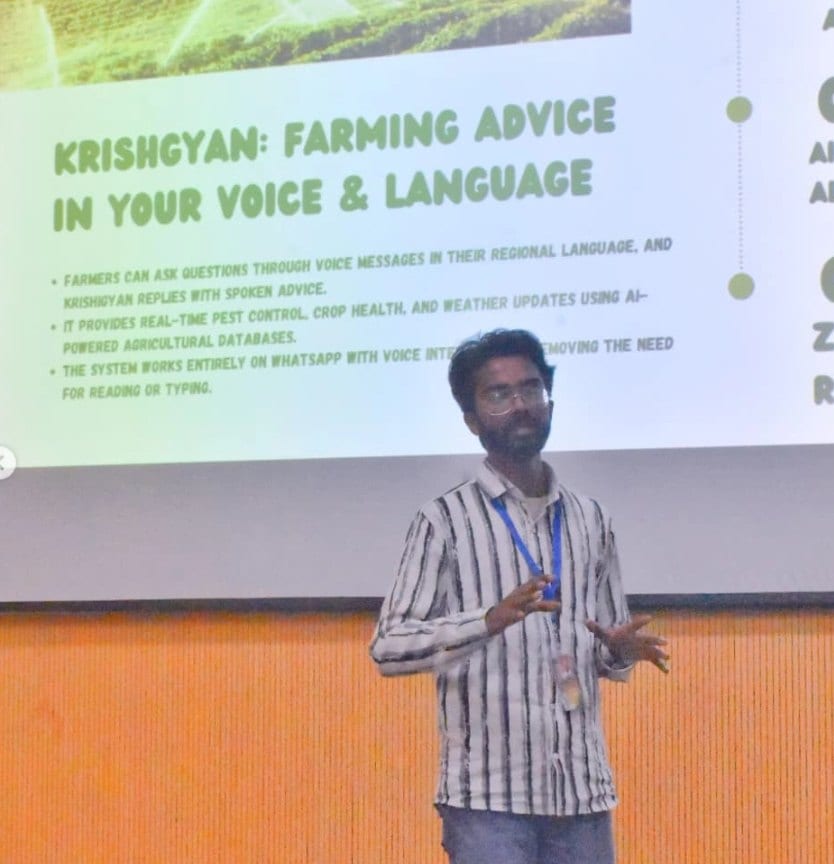
Where these systems get explained to students.

Read next
Agents in depth.
An agent that does real work for your team?
I scope which steps need an agent, build the tools and limits, and prove it with test tasks.