
The pitch is where good projects are won or lost.
A pitch deck is a short set of slides that carries a story: the problem, who has it, the demo, how it works, what you measured, what is next, and the team. At a hackathon you get two to five minutes and the demo is the centre; the slides exist to frame it. Judges follow stories about users, not lists of features. My template and the two-minute structure are public.
- Length
- Two to five minutes; six to eight slides
- Centre
- A live demo with real input, plus a backup video
- Order
- Problem, user, demo, how, number, next, team
- Rehearse
- Three times, timed, with questions

- 3first prizes
- 10+hackathons judged
- 200+students mentored
Questions students ask
The pitch and deck questions searched most, answered from pitching and judging.
What is a pitch deck?
A pitch deck is a brief presentation, usually ten to fifteen slides for investors and six to eight for a hackathon, that explains a product or venture to an audience that must decide something: fund it, award it, adopt it. It covers the problem, the people who have it, the solution, how it works, evidence that it works, the market or impact, the team, and the ask. The term comes from startup fundraising, and hackathon finals borrow the format in miniature. Its purpose is to make a decision easy, so every slide answers a question the audience is already asking.
How to make a good pitch deck
- Start with the problem and the person who has it; make the audience feel the pain in two sentences.
- Show the product, do not describe it: a live demo or a short video, with real input and output.
- One slide on how it works, with a diagram, pitched at the level of the audience.
- One honest number: accuracy on your test cases, time saved, users, documents processed.
- The limitation you know about and what you would do next; credibility comes from candour.
- The team and who did what; the ask, if there is one.
- One idea per slide, large type, few words; the speaker carries the detail.
How many pages should a pitch deck be?
As few as carry the story. Investor decks run ten to fifteen slides for a twenty-minute meeting. Hackathon decks run six to eight for a two- to five-minute pitch: title, problem and user, demo, how it works, results, what is next, team. If you have more slides than minutes, you have too many. Appendix slides for anticipated questions, architecture detail, data sources, costs, are useful after the pitch and should not be in the main flow. Judges remember one problem, one demo and one number; design for that memory, not for completeness.
How to design pitch deck
Design for a room, not a screen: large type readable from the back, high contrast, one visual per slide, consistent fonts and colours, and no walls of text. Use screenshots of the real product rather than stock images. Keep a title on every slide that states the point of the slide as a sentence, so a judge who looks up mid-pitch gets the message. Put the demo in the middle, at the point where the audience understands the problem and wants to see the answer. Build it in whatever tool the team knows; the content and the rehearsal matter far more than the template. My pitch deck template on the answers site is a starting structure.
How to create pitch deck using AI
Give an assistant your problem statement, what you built, your results and your team, and ask for a six-slide outline with a one-sentence title per slide and three bullets of speaker notes each; then edit it in your own words and cut anything generic. Slide tools with AI features will generate layouts and images from that outline. Use a model to tighten titles and to draft answers to likely judge questions. Do not let it invent numbers or claims; every figure on the deck must be yours. The best use of AI here is time: an outline in minutes leaves hours for the demo and the rehearsal, which are what score.
Can Gemini make PPT?
Gemini can draft the outline, the titles and the speaker notes of a presentation in the chat app, and inside Google Slides its features generate slides and images from a prompt for accounts that have them enabled; it can also produce a structured outline you paste into any slide tool. The result is a starting point, not a finished pitch: the content must be your real project, the demo must be real, and the design should be simplified for a room. Other assistants have similar capabilities and dedicated presentation tools generate full decks from a prompt. Whatever you use, rehearse with the final slides, because timing changes when the slides change.
How do hackathon presentations work?
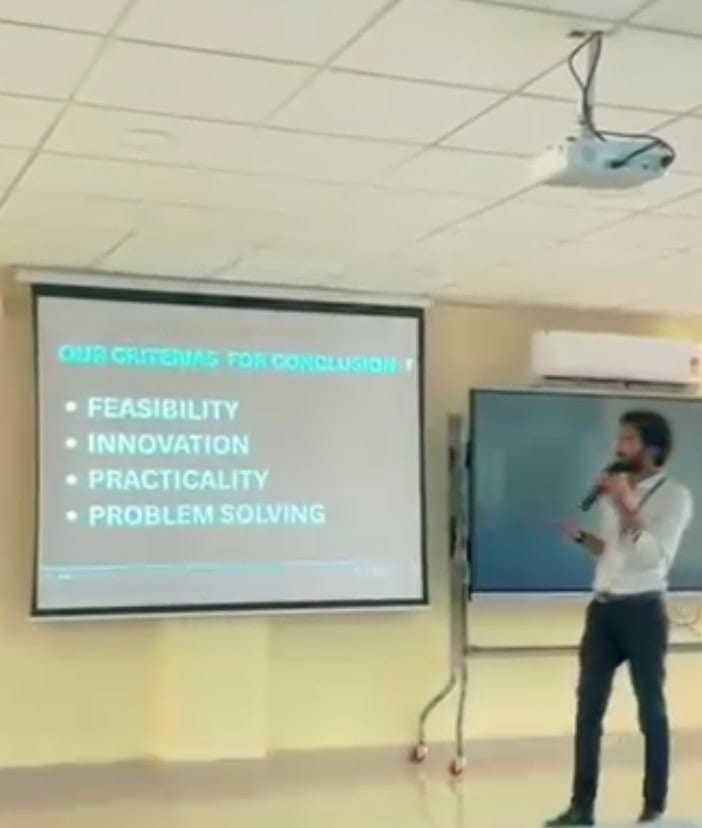
At submission time, teams typically upload code, a short write-up and sometimes a video. At the finals, each team presents in turn to a judging panel for a fixed slot, often two to five minutes of pitch plus a few minutes of questions, with a shared screen or projector. Judges score against a rubric during or after each presentation; some events run a first round of table demos where judges circulate, then a final on stage for the top teams. Order is usually random; prepare for being first and for being last. Have the demo loaded and the backup video ready before you walk up.
How long should a hackathon pitch be?
As long as the slot allows and not a second more: two, three or five minutes depending on the event, with questions after. Plan for the shorter end, because setup and nerves eat time, and rehearse with a timer until you finish with a margin. In a two-minute slot, the demo gets at least half; in five, you can afford a how-it-works slide and a results slide. If the organisers do not specify, assume three minutes. A pitch cut off by the clock before the demo is the most common self-inflicted loss I see from the judging table.
Example hackathon presentation
- Slide one, ten seconds: project name and one line on what it does.
- Slide two, thirty seconds: the problem and the person, 'first-years cannot find which form to file and miss deadlines'.
- Slide three, sixty to ninety seconds: live demo, a real question typed in, the answer with a citation to the rule book page.
- Slide four, twenty seconds: how it works, one diagram, retrieval over the rule book with citations and a decline path.
- Slide five, fifteen seconds: what we measured, right answer in the top three on eighteen of twenty test questions; one known limitation.
- Slide six, ten seconds: what is next and the team with roles.
- Then questions; every member ready to answer about their part.
Best pitch deck examples
The classic startup decks that are studied publicly share the structure above and are worth reading once to see how little text a strong deck carries. For hackathons, the best examples are the winning teams at your own event; watch them, note the order of their slides and the length of their demo, and copy the shape. On my answers site I publish the pitch deck template I give student teams and a carousel on the two-minute pitch, both drawn from decks that won and from scoring hundreds that did not. The pattern in all of them: a user you believe in, a demo that works, and one number.
Demo-proof the pitch
The checklist for the hour before you present.
- 01
Backup video
Recorded, on the laptop and on a phone, in case the network or the build fails.
- 02
Demo data
Inputs prepared that make the point in seconds; nothing typed from memory on stage.
- 03
Timing
Three timed rehearsals; the demo starts before the halfway mark.
- 04
Questions
Five likely questions answered in one sentence each; every member owns one.
At the table
Judging, mentoring and the odd trophy.

Read next
Winning, judging and the demo itself.
Want your finalists to pitch like winners?
I run a short pitch clinic before finals and judge with written feedback on the pitch as well as the build.