
A team that finishes beats a team of stars.
Hackathon teams are small, usually two to five people, and win on complementary roles and on finishing: someone owns the core build, someone the interface, someone the data or model, someone the pitch and demo. Find teammates through communities, past events and the event's own matching; lead by scoping hard and integrating early. I have led winning teams and watched many strong ones fail on coordination.
- Size
- Two to five; six for Smart India Hackathon
- Roles
- Build, interface, data or model, pitch and demo
- Find teammates
- Communities, past events, event matching
- Lead by
- Scope, roles, integration checkpoints

- 3first prizes
- 10+hackathons judged
- 200+students mentored
Questions students ask
The team questions searched most, answered from leading teams and briefing judges.
What is a hackathon team?
A hackathon team is the small group that registers together, builds one project during the event and presents it as a unit; prizes and credit go to the team. Most events allow two to five members, some permit solo entries, and national programmes specify an exact size. The team is responsible for everything: choosing the problem, building, integrating, submitting on time and pitching. A good team is not the five best coders available; it is a set of people whose skills cover the whole demo and who can make decisions quickly together. Teams that form the night before and have never worked together still win, if the roles are clear.
How many members in hackathon team
Most hackathons allow between two and five members, with three or four the most common and the most effective: enough hands to cover build, interface, data and pitch, few enough that everyone knows what everyone else is doing. Larger teams spend their time coordinating and splitting work that does not split. Solo entries are allowed at some events and are viable only with a tiny scope. Read the rules, because the size is enforced at registration and at submission, and because some events require a minimum, including diversity requirements such as at least one female member.
How many team members in Smart India Hackathon
Smart India Hackathon specifies a team of six students from the same institute, with a requirement that at least one member is female, plus a faculty mentor; the exact wording is in each edition's rules and should be checked on the official site before registering. Six is larger than most hackathon teams, which makes role definition matter even more over the longer timeline: typically two on the core build, one on data and integration, one on the interface, one on domain research and documentation, and one on the presentation and the evaluators' questions, with roles overlapping as the finale approaches.
What are the roles in a hackathon team?
- Core builder: owns the main logic, the backend or the model pipeline; the thing the demo depends on.
- Interface: the screen judges see; clarity over beauty; demo data that makes the point.
- Data and model: collecting and preparing the data, running the model, checking outputs, measuring something.
- Pitch and demo: the story, the slides, the video, the rehearsal, the questions; starts on day one, not at the end.
- Integrator and scope keeper: often the leader; makes sure parts connect by the midpoint and says no to new features.
- In small teams people hold two roles; in AI projects the data and model role is the one most often under-staffed.
How to find hackathon teammates
Before the event: campus coding clubs and tech communities, people you have done course projects with, previous hackathon teams, online communities for the event, and the organisers' matching channels, where you post your skills and what you need. At the event: the team-formation session, where organisers help solo participants find each other; say clearly what you can do and which role you want. Look for complementary skills and compatible temperaments more than for the strongest coder. Many lasting teams started as strangers matched at registration; what made them last was the first event's result and the habit of finishing. The team formation carousel on my site covers the conversation to have.
How to form a hackathon team
- Decide the roles you need from the demo you intend to build, then recruit for the gaps, not for friends.
- Agree the time commitment and the goal: learn, finish, or win; mismatched goals break teams at hour twenty.
- Set up before the event: repository, chat channel, deploy target, a template for your stack, model keys.
- Draft two or three problem ideas together and pick one at kick-off with the demo script written.
- Assign roles explicitly and write them down; ambiguity is where time disappears.
- Name the integrator who owns scope and the midpoint merge.
How to lead a hackathon team
Lead by removing decisions. In the first hour, drive the choice of problem and the smallest demo, write the demo script, assign roles and set checkpoints: a working ugly path by the midpoint, a feature freeze a few hours before submission, three pitch rehearsals. During the build, keep the scope: every new idea goes on a list for after the demo works. Watch for blocked teammates and unblock them, by pairing or by cutting the feature. Keep morale practical: food, breaks, a short sleep rota. Before judging, make sure every member can answer one question about their part. The leader's job is finishing; the trophy follows.
How to mentor junior team members
Give juniors a real, bounded piece with a clear definition of done, such as the interface for one screen or the data loader, and pair with them for the first hour so they are not stuck silently. Review their work early rather than at integration. Explain the why of decisions so they learn scoping, not only syntax. Let them present part of the pitch; it is the fastest confidence builder. Mentoring at hackathons is how communities reproduce; the juniors you unblock this year lead teams next year. I mentor first-years the same way on campus, and the mentoring carousel on my site describes the pattern.
What tools do AI teams use during a hackathon?
A shared repository with branches and a deploy-on-push target so the demo is always live; a chat channel; a task board with the demo script at the top; AI coding agents in the editor for speed, with the rule that the author reads every diff; a model API with a free tier or a local model through Ollama for private data; a vector store such as pgvector or Chroma if retrieval is involved; a simple front-end framework the team already knows; a slide tool and a screen recorder for the backup demo video. Set all of it up before the event; the first hour is for the problem, not for installing things.
Panel judging vs solo judging: why a hackathon needs more than one judge in the room
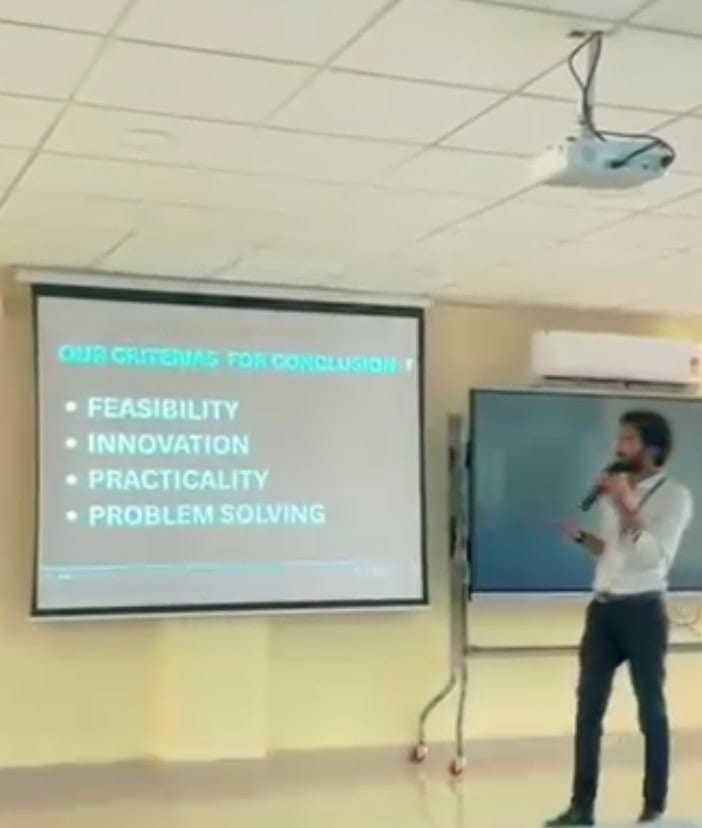
A single judge brings one set of blind spots: a preference for a technology, a fatigue curve across forty pitches, a soft spot for a polished talker. A panel of three to five with a shared rubric averages those out, lets technical, product and design perspectives each weigh in, and makes scores defensible when teams ask why they placed. Panels also catch what one person misses, such as a demo that was pre-recorded or a project that was built before the event. When I brief judging panels, we agree the rubric, calibrate on two early teams, score independently, then discuss only where scores diverge; that process produces results teams trust.
Team setup in one evening
What to do before the event starts.
- 01
Roles and goal
Four roles written down; agree whether you are there to learn, finish or win.
- 02
Tooling
Repository, deploy target, chat channel, stack template, model keys; tested.
- 03
Ideas
Two or three problems with a named user each; the demo script for the favourite.
- 04
Checkpoints
Midpoint integration, feature freeze, three pitch rehearsals; on the calendar.
At the table
Judging, mentoring and the odd trophy.

Read next
The rest of the hackathon playbook.
Need a judging panel that agrees on a rubric?
I brief panels before finals, score with a public rubric, and write feedback every team can use.