
A chatbot that answers from your content, with sources.
A modern website chatbot is a language model behind a chat box, grounded in your pages and documents through retrieval, so it answers questions about your product, course or service accurately and cites where the answer came from. Build it in Python with FastAPI or in Next.js with a streaming route, and give it a decline path for questions your content does not cover.
- Old chatbot
- Scripted menus and keyword rules
- AI chatbot
- A model that understands and generates
- RAG chatbot
- A model that answers from your content with citations
- I built
- RAG.NextUpgrad; the assistant on this site

- 5production AI apps
- 14engineers led
- 200+students mentored
Questions students ask
The chatbot questions searched most, answered from building several.
How to build chatbot
- Decide what it must answer and what it must refuse; write twenty real questions with ideal answers.
- Collect the content it should answer from: pages, docs, FAQs, policies; chunk and index them.
- Build the backend: an endpoint that takes the message and history, retrieves relevant passages, calls a model with a system prompt that enforces answering from passages with citations, and streams the reply.
- Build the chat widget: a message list, an input, streaming rendering, and source links; embed it on the site.
- Add a decline path and a handoff: when the content has no answer, say so and offer a contact form or email.
- Log every conversation; review weekly; add failures to the test set and content gaps to the knowledge base.
Difference between chatbot and AI chatbot
A traditional chatbot follows a script: decision trees, menus, keyword matching, canned responses. It is predictable, cheap and frustrating the moment a user phrases something unexpectedly. An AI chatbot uses a language model to understand what the user means, in any wording, and to generate a reply, so it handles open questions and follow-ups naturally. The risk moves from 'did not understand' to 'answered confidently and wrongly', which is why serious AI chatbots are grounded in retrieved content and constrained by a system prompt rather than left to improvise. Many products combine both: scripted flows for transactions, an AI layer for questions.
How do generative AI chatbots work?
Each turn, the application assembles a prompt: a system message defining the bot's role and rules, any retrieved context relevant to the question, the recent conversation and the new message. The model generates a reply token by token, which is streamed to the widget. Tool calls can be included, for example to look up an order or book a slot, with the result fed back before the final answer. Memory within a conversation is simply the history resent each turn; memory across conversations needs storage keyed to the user. The quality depends far more on the retrieval and the system prompt than on which model you pick.
What is RAG AI chatbot?
A RAG chatbot is an AI chatbot that retrieves passages from a knowledge base for every question and answers only from them, with citations. The knowledge base is your content, chunked and indexed with embeddings and keywords; retrieval runs on the user's message, rewritten into a standalone question from the conversation; the model reads the top passages and composes the answer. It keeps the bot accurate on your specifics, lets you update it by editing content rather than retraining anything, and shows users where answers came from. RAG.NextUpgrad is the production version I built, with hybrid search, re-ranking and a confidence gate that declines on weak evidence.
RAG vs AI chatbot
A plain AI chatbot answers from the model's general knowledge plus whatever you paste into the system prompt; it is fine for general help and small, fixed context. A RAG chatbot adds retrieval so it can answer from a large or changing body of your own content and prove it. Choose plain when the knowledge fits in a short system prompt and does not change; choose RAG when users will ask about your documents, your catalogue, your policies or your course material. The build cost of RAG is an indexing pipeline and a test set; the payoff is answers you can trust and update.
How to build a RAG chatbot with Python
Chunk your content by structure and embed it with an open model into pgvector or FAISS; add a BM25 index. Write a FastAPI endpoint that accepts the message and history, rewrites the message into a standalone question, retrieves from both indexes, fuses and re-ranks the candidates, checks that the best evidence is strong enough, and streams a model answer with citation markers as server-sent events. Keep the prompt strict: answer only from the passages, cite them, say when they do not cover the question. Add a test set of real questions and run it after every change. The RAG pipeline page on this site walks through each stage.
How to make Python AI chatbot
The minimal version is a loop: read a user message, append it to a message list, send the list with a system prompt to a model API (or a local model through Ollama), print the streamed reply, append it, repeat. That is a working chatbot in twenty lines and the right first exercise. To make it useful, add a system prompt that defines a role, a retrieval step over a folder of your documents, structured output for anything a program will consume, and logging. To make it a product, put it behind FastAPI with a chat widget, rate limits and a decline path. Each step is a weekend; the first step is an evening.
Next JS AI chatbot tutorial
In Next.js, create a route handler that receives the messages, runs retrieval if you have it, calls the model with a streaming helper (the Vercel AI SDK makes this a few lines and works with any provider) and returns the stream. On the page, use the SDK's chat hook to manage messages and render tokens as they arrive, with a component that turns citation markers into links. Keep the API key in server environment variables so the browser never sees it. Deploy to Vercel's free plan, which is how this site and its assistant run. For heavy retrieval or Python-only libraries, keep the retrieval in a FastAPI service and call it from the route.
Examples of generative AI chatbots
- General assistants: ChatGPT, Claude, Gemini, Copilot.
- Documentation bots on developer sites that answer from the docs with links.
- Support assistants that resolve common questions and hand off the rest to a person.
- Course tutors grounded in lecture notes with page citations.
- Sales assistants that answer product questions and capture leads.
- Internal helpdesks over company policies and IT guides.
- The assistant on this site, which answers about my work from a curated knowledge base; I describe the pattern under the knowledge-base chatbot page.
How many AI chatbots are there?
Uncountable, and the number is not useful. A handful of general assistants dominate usage; beneath them sit thousands of products with a chatbot feature and millions of custom bots built by businesses, students and hobbyists on the same model APIs, with more created every day through no-code builders. What matters when you evaluate one, or build one, is not novelty but grounding, honesty and handoff: does it answer from real content, does it cite, does it decline when it should, and does it get a person involved when it cannot help. Those four properties separate the chatbots people trust from the ones they close.
Ship a website chatbot in a week
The build order that gets to trustworthy fastest.
- 01
Twenty questions and the content
Real questions with ideal answers; the pages and documents that contain them, indexed.
- 02
Grounded endpoint
Retrieve, gate, answer with citations, stream; a strict system prompt; a decline path.
- 03
Widget and handoff
Streaming chat on the site; source links; contact form or email when it cannot help.
- 04
Logs and iteration
Review conversations weekly; fill content gaps; grow the test set; run it in CI.
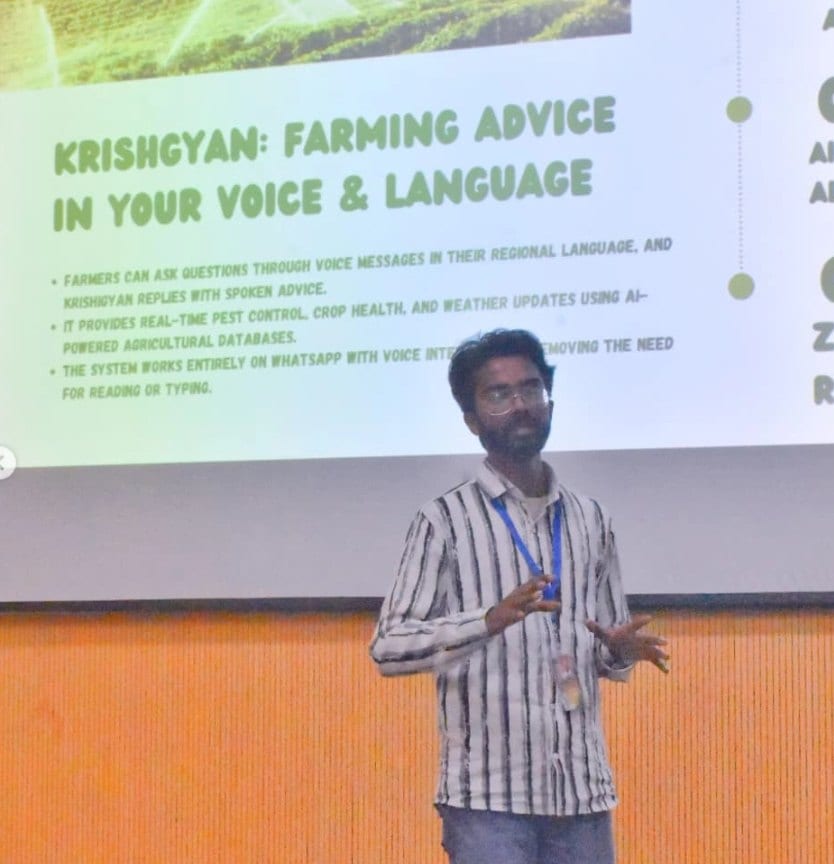
In the room
Where these systems get explained to students.

Read next
The retrieval and serving behind the chat box.
A chatbot your visitors will actually trust?
I build grounded, cited assistants with a decline path and a test set, on your site, in a week.