
The roadmap is a portfolio, not a syllabus.
An AI engineer builds products on models: retrieval systems, extraction pipelines, agents, evaluation, deployment. The path in 2026 is Python and software fundamentals, three shipped AI projects with write-ups, the machine learning basics you need to evaluate and fine-tune, and visibility through community and talks. I followed it from a BCA degree, and it works without any degree at all.
- Core skills
- Python, APIs, retrieval, evaluation, deployment
- Proof
- Three shipped projects with public write-ups
- Degree
- Helpful, not required; portfolio decides
- My path
- BCA, five shipped apps, 200+ students mentored

- 200+students mentored
- 20+campus sessions
- 5production AI apps
Questions students ask
The roadmap questions searched most, answered from walking it.
How to become AI engineer
- Learn Python properly and the basics of building software: Git, a web framework, databases, testing.
- Build and ship three AI projects of increasing depth: a grounded assistant with citations, an extraction pipeline with validation, an agent or a fine-tuned model with honest evaluation.
- Learn the machine learning you need along the way: how models are trained, overfitting, evaluation metrics, embeddings, transformers at a conceptual level.
- Learn deployment: containers, a cloud platform, CI, monitoring, cost control.
- Publish everything: code, live links, write-ups of what failed.
- Be visible: a community, a talk, open-source contributions. Then apply with the portfolio.
AI engineer roadmap 2026
What changed by 2026: models are good enough that the hard part is the system around them. The roadmap therefore weights retrieval, evaluation, tool design, security and cost over model training. Quarter one: Python and a first grounded assistant. Quarter two: a document pipeline with structured output and validation, deployed. Quarter three: an agent with scoped tools, limits and test tasks, plus a fine-tune of a small model on a free GPU with a before-and-after comparison. Quarter four: polish, write-ups, a talk, applications. Throughout, use AI coding tools daily and read every diff; knowing how to work with them is now part of the job.
What to learn to become AI engineer
- Python: fluent, including async, typing, packaging and testing.
- Web and data: FastAPI or a JavaScript equivalent, SQL and Postgres, REST and webhooks.
- Models: calling APIs, prompting as specification, structured output, tool calling, running open models locally.
- Retrieval: chunking, embeddings, hybrid search, re-ranking, evaluation with recall and faithfulness.
- Evaluation: test sets, metrics, LLM judges validated against humans, CI.
- Fine-tuning basics: LoRA and QLoRA, datasets, loss curves, overfitting.
- Deployment and operations: Docker, a cloud platform, logging, cost, rate limits, fallbacks.
- Security: prompt injection, least privilege, data minimisation.
- Communication: write-ups, demos, explaining trade-offs to non-engineers.
How to become AI engineer without a degree
Build the portfolio the degree would have been a proxy for. Employers use degrees as a filter when they have nothing else to go on; a public body of shipped work with live links, clean code and honest write-ups gives them something better. Contribute to open source so there is evidence you can work with others. Get a first paid project any way you can: freelance, an internship, a small company, a startup building AI features, and let the title catch up. Prepare for the interviews, which test practical understanding more than credentials. Many of the strongest engineers I know in this field came in sideways; the field is young and the work is visible.
How to become AI engineer in India after 12th
Choose a degree that gives you time to build: computer science, BCA, or any programme with a strong computing core; the name matters less than the hours you can spend coding. Start building from the first semester rather than waiting for the final year, because four years of shipped projects is an unbeatable portfolio at graduation. Join or start a campus tech community; speak at its events; take internships from the second year. Use the free resources on this site and elsewhere; the materials are world-class and free. The guide on BCA versus BTech for an AI career covers the degree choice in detail, and my own path from BCA is written up as an example.
How to become AI engineer after 10th
Keep the long view and start the habits now. In the next two years, learn Python seriously, take mathematics through the end of school because the fundamentals matter later, and build small projects: a game, a tool for your family, a script that automates something at school. Join online communities and follow the field without being overwhelmed by it. Choose a stream and then a degree with a computing core. By the time you enter college you will be years ahead of classmates who start then. There is no shortcut that skips the years of building, but there is a head start, and it begins with the first script.
How to become machine learning engineer
A machine learning engineer trains, evaluates and deploys models, often on a company's own data, and needs more depth in the fundamentals than an AI engineer who mostly builds on hosted models. Add to the roadmap: the mathematics of training (linear algebra, calculus, probability) at a working level, hands-on experience training models in PyTorch, data engineering for building and cleaning datasets, experiment tracking, and serving infrastructure. Kaggle competitions and reproducing a paper are good practice. The two roles overlap heavily and many people move between them; start with whichever lets you ship something real soonest, which for most students is the AI engineer path.
How to become AI freelancer
Pick a narrow, valuable service you can deliver end to end: a document-processing pipeline, a grounded support chatbot, an automation for a specific kind of business. Build a demo and a case study by doing it for someone you know. List on freelance platforms and, more effectively, reach out directly to businesses in one niche with a specific offer. Price by outcome and scope rather than by the hour; put maintenance in every contract because AI systems need it. Deliver with tests, documentation and a handover so clients come back. Freelancing teaches scoping and communication faster than any job, and several of my mentees started this way before taking full-time roles.
How to become AI product manager
An AI product manager decides what to build with models and whether it is working, which requires understanding what models can and cannot do, how to evaluate them, what they cost and where they fail. The path: build at least one AI product yourself, even a small one, so the trade-offs are real to you; learn evaluation deeply, because judging quality is the core of the job; learn the economics of tokens and latency; and practise writing specifications for AI features that include success metrics and failure handling. Product roles usually come from inside a company, so an engineering, design or analytics role on an AI team is the common entry.
How to become guest lecturer in college
Colleges invite people who have done something students want to learn and who can explain it. Build the thing first; then write and speak about it publicly so faculty and student clubs can find you. Offer a specific session with a clear outcome, such as a hands-on workshop where students leave with a working RAG app, rather than a general talk. Reach out to the student community leads and the placement or training cell, who book speakers. Deliver well once and invitations follow; my own speaking started with a single induction seminar and grew to more than twenty sessions. The guide on giving a guest lecture covers the structure and the logistics, and the speaker page explains how I work with colleges.
Twelve months, four milestones
The version of the roadmap that fits beside a degree or a job.
- 01
Foundations and first build
Python, Git, FastAPI; a grounded notes assistant deployed with citations.
- 02
Documents and data
An extraction pipeline with schema validation and a test set; Docker and CI.
- 03
Agents and tuning
An agent with scoped tools and test tasks; a QLoRA fine-tune with honest evaluation.
- 04
Visibility and applications
Write-ups, a talk, open-source contributions; interviews prepared from real questions.
With students
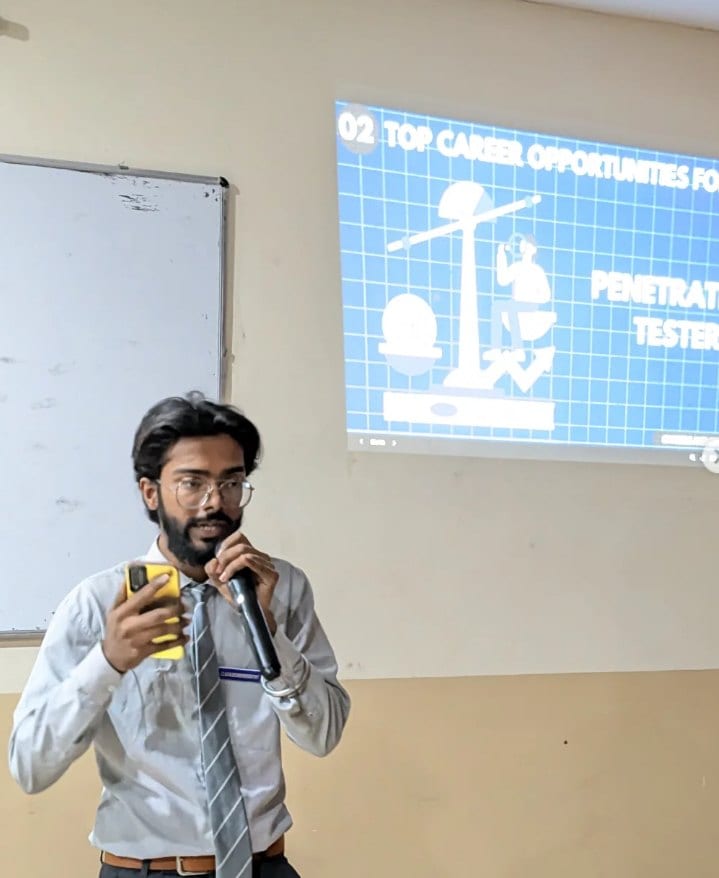
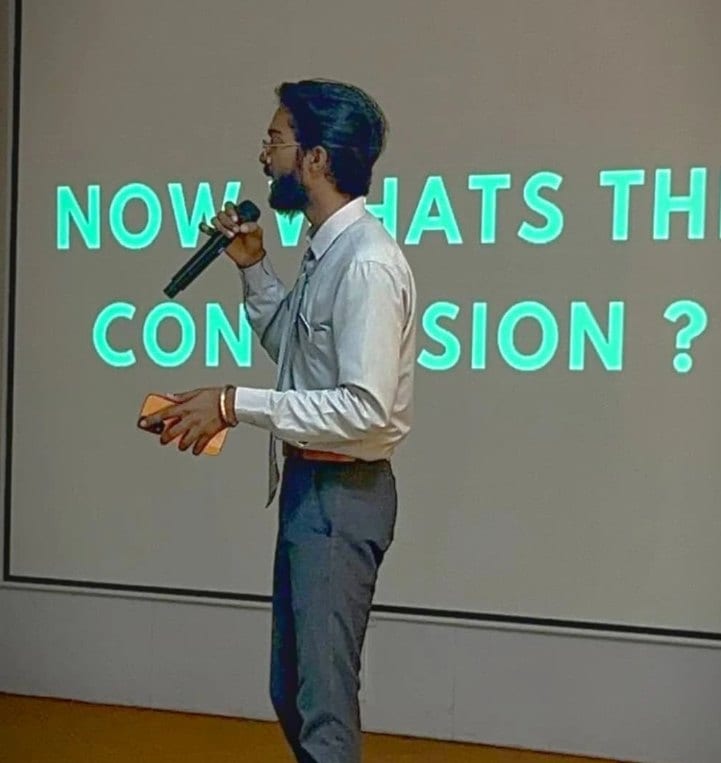
Sessions where this advice gets given in person.
Want the roadmap tailored to where you are?
I mentor students and career-changers through it, project by project, until the portfolio gets the job.