
Learn AI by building something that works.
The fastest way to learn AI in 2026 is backwards from a working project: learn enough Python to be dangerous, build an assistant over your own notes with a language model, then learn the machine learning fundamentals you now have a reason to understand. Everything you need is free. I have taken more than two hundred students through this order.
- Order
- Python, build, fundamentals, specialise
- Cost
- Zero: free courses, free model tiers, free GPUs
- Proof
- A portfolio of shipped projects, not certificates
- I have
- Mentored 200+ students across 20+ sessions

- 200+students mentored
- 20+campus sessions
- 5production AI apps
Questions students ask
The learning questions searched most, answered from mentoring students who got jobs.
How to learn AI
Start with a project you want to exist, not with a syllabus. Choose something small and real: an assistant that answers questions from your lecture notes, a tool that sorts your email, a classifier for photos of your own things. Learn Python to the level the project needs. Build it with a language model API or a local model, using the free tiers. When it works, you will have hit the limits of what you understand, and those limits are your syllabus: how embeddings work, why retrieval misses, what a model is doing when it predicts the next token. Learn those with a purpose, then build the next thing.
How to learn AI from scratch
- Month one: Python basics through a free course; functions, lists, dictionaries, files, and calling an API. Write small scripts daily.
- Month two: build a chat assistant over your own documents with a model API or Ollama; chunking, embeddings, retrieval, citations. Ship it to a free host.
- Month three: fundamentals with purpose; what a neural network is, how training works, what a transformer does, through one solid free course and a notebook or two.
- Month four: a second project in a different area, such as a vision app in the browser or a fine-tuned small model on a free GPU.
- Throughout: write up every project publicly; join a community; present once. The guides on my answers site give the free resources for each step.
How to learn AI for beginners
Beginners stall on two things: too much theory before any practice, and tools that hide what is happening. Avoid both. Use plain Python and a provider SDK rather than a framework for your first build so you see every step. Keep mathematics for later; you need arithmetic and the idea of a vector to build useful things, and you can learn the calculus and linear algebra behind training when you are ready to train. Use AI assistants to explain code and errors, not to write the whole project for you; the explaining is where learning happens. Expect to be confused for a few weeks; everyone is.
How to learn AI for free
Everything in the path above is free. Python: the official tutorial and free university courses. Fundamentals: free courses from universities and from the major AI education platforms, and free books. Models: the free tiers of Gemini and Groq, and open models through Ollama on your own laptop. GPUs for fine-tuning: Google Colab and Kaggle. Hosting: Vercel, Render, Hugging Face Spaces. Reading: provider documentation, which is better than most paid courses. Community: open-source projects and Discord servers. What you cannot get for free is time; protect a few focused hours a week and the money question disappears.
How to learn machine learning
Machine learning is the broader discipline underneath AI products: training models from data to predict or classify. Learn it after your first generative AI project, when you have a reason. One good course on supervised learning (regression, classification, overfitting, evaluation) with hands-on notebooks; scikit-learn for classical methods on tabular data; then PyTorch for neural networks, training a small image classifier yourself so you see loss curves and overfitting with your own eyes. Enter one Kaggle competition for the experience of a leaderboard. The fundamentals pay off most when you fine-tune, evaluate and debug the AI systems you build.
How to learn machine learning roadmap
- Python and NumPy, pandas for data handling, matplotlib for plots.
- Statistics basics: distributions, mean and variance, correlation, the idea of a hypothesis test.
- Supervised learning with scikit-learn: linear and logistic regression, trees and forests, cross-validation, metrics.
- Neural networks in PyTorch: a small classifier from scratch, then a pretrained model fine-tuned.
- One deeper area: transformers and language models, or computer vision, or recommendation.
- Practice: a Kaggle competition, a dataset from your own life, and a write-up of what the model got wrong and why.
Should I learn machine learning?
If you want to build AI products, you need enough machine learning to understand what models do, how they fail, and how to evaluate them; you do not need to become a researcher. If you want to train models, do research or work on model infrastructure, you need much more, including the mathematics. If you are curious whether it is for you, the answer comes from a weekend: fine-tune a small model on a free GPU, plot the loss, compare the result with the base model. If that was fun, continue. Most of the people I mentor end up as builders who use machine learning rather than specialists in it, and that is a strong, employable position.
How to learn AI engineering
AI engineering is building reliable products on top of models: retrieval, prompts, tools, evaluation, deployment, cost and security. Learn it by shipping: a grounded assistant with citations and a test set; an extraction pipeline with validation; an agent with scoped tools and limits; each deployed, each with a write-up. Learn the surrounding software skills, APIs, databases, containers, CI, because they are most of the job. Read provider documentation and a few strong engineering blogs rather than hype. The positioning pages on this site describe what the work looks like in practice, and the guide on becoming an AI engineer gives the step-by-step version.
How to get into AI jobs
Portfolio first. Three shipped projects with public code, live links and honest write-ups beat any list of certificates; hiring managers can see what you can do. Target roles where the work matches your projects: AI engineer, applied ML, data roles, or developer roles at companies building AI features. Contribute to an open-source project in the space; it is proof of collaboration. Speak or write about what you built; visibility brings opportunities. Apply widely, including to small companies where one person builds the whole feature. Prepare for interviews with the questions teams actually ask, which I collected in the GenAI interview guide. Internships and freelance projects count as experience; take them.
How to learn AI prompting
Use a chat model for real tasks every day and keep notes on what worked. Read one provider's prompting guide. Rewrite the same request five ways and compare. Then build something where the prompt is code: a system prompt, a template, a test set of inputs, and a loop that shows you where it fails. Prompting on its own is a small skill; prompting inside a system with retrieval, tools and evaluation is where it becomes valuable, and the prompt engineering page on this site covers that progression. Treat prompts as specifications, test them, and you will be better at it than most people claiming the title.
Your first ninety days
The plan I give every first-year who asks.
- 01
Days 1 to 30
Python daily; small scripts; one API call to a model with a free key.
- 02
Days 31 to 60
A notes assistant with retrieval and citations; deployed to a free host; a write-up.
- 03
Days 61 to 90
Fundamentals course with purpose; a second project in vision or fine-tuning; one talk or post.
- 04
Then
A community, an internship application, and the next project. Repeat.
With students
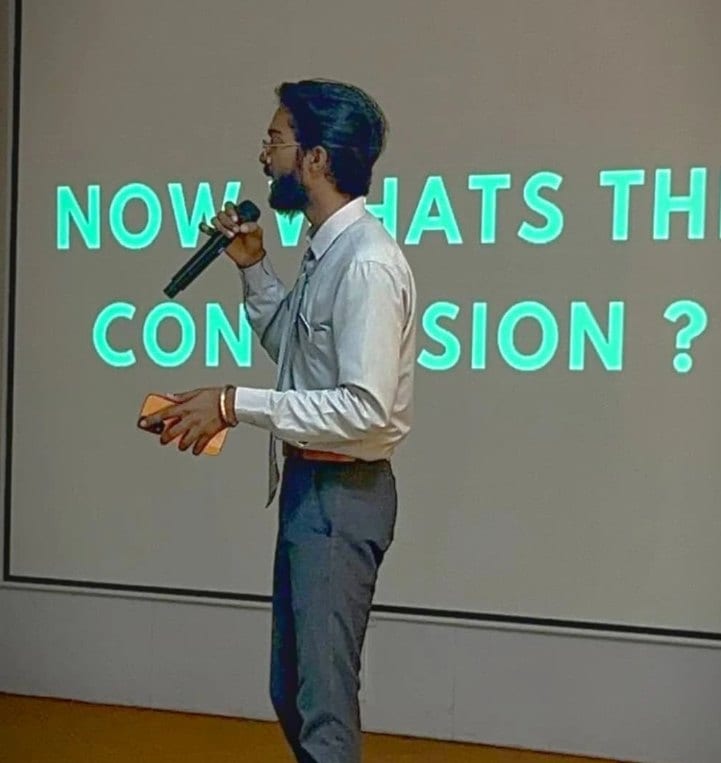
Sessions where this advice gets given in person.

Want a mentor who has done it?
I mentor students from first project to first job, with the same standards I use in production.