
AI engineering is software engineering, plus models.
The AI versus web development question has a false premise: AI products are web products with a model inside, and AI engineers are software engineers who also know retrieval, prompting, evaluation and deployment of models. Learn the web and software fundamentals, then add the AI layer. Jobs are shifting, not vanishing, towards people who can do both.
- Web dev
- Interfaces, APIs, data, deployment
- AI engineer
- All of that, plus models, retrieval, evals
- What AI changes
- Speed of routine work; value of judgement
- Learn
- Both, in that order

- 200+students mentored
- 20+campus sessions
- 5production AI apps
Questions students ask
The AI versus software questions searched most, answered from doing both.
AI engineer vs software engineer
A software engineer designs, builds, tests and operates software: interfaces, services, databases, infrastructure. An AI engineer does the same with a model in the loop, which adds a set of problems ordinary software does not have: outputs that are probabilistic, inputs that are unstructured, quality that must be measured with evaluation sets rather than asserted with unit tests, costs that scale with tokens, and new failure modes such as hallucination and prompt injection. Every AI engineer I respect is a solid software engineer first. The reverse is becoming true as well: most software teams now ship features that call a model.
Software vs AI engineer
Day to day, the overlap is large: both write code, review pull requests, debug production, talk to users and ship. The difference is where the hard problems sit. A software engineer's hard problems are architecture, correctness, performance and scale. An AI engineer's are retrieval quality, prompt and tool design, evaluation, latency and cost of model calls, and safety. The AI engineer spends more time reading model outputs and building test sets, and less time on classic algorithms. If you enjoy systems and certainty, software; if you enjoy working with messy inputs and measuring fuzzy quality, AI; most people can do both and the market rewards both.
AI vs software engineering
As fields of study, software engineering is the mature discipline of building reliable systems; AI engineering is a young layer on top that borrows its practices and adds its own: evaluation-driven development, grounding, agent design, model operations. There is no AI engineering without software engineering underneath; a retrieval pipeline is a data pipeline, an agent is a service with a loop, a chatbot is a web app with streaming. The students who try to skip the foundation and go straight to prompts build demos that cannot ship. The ones who build the foundation and add AI become the engineers every team is trying to hire.
Is learning web development worth it in an AI era?
Yes, with a change of emphasis. AI tools now write a lot of routine front-end and back-end code, so the value of typing out a form by hand has fallen. The value of knowing how the web works, HTTP, rendering, state, data, security, performance, accessibility, deployment, has risen, because you need it to specify what the tools build, to review their output and to fix what they get wrong. Every AI product has a web interface and an API. Learn web development as the foundation, use AI tools to move faster, and spend the time you save on the parts the tools cannot judge for you.
Is AI leading to reduced jobs? What it means for software engineers
Entry-level roles that consisted mostly of routine implementation are fewer and more competitive, and that is real; the number of people who can produce working code has grown enormously. Roles that need judgement, system design, product understanding, debugging of complex failures and the ability to direct AI tools well are growing, and AI product teams are hiring. For a student the implication is clear: do not compete with the tools at what they do well; become the person who specifies, reviews, integrates and ships, and who understands the AI layer deeply. Visible shipped projects matter more than ever, because they prove that judgement.
AI engineer vs software engineer salary
AI engineering roles currently command a premium over general software roles at the same level in most markets, because demand outruns supply, and the premium is largest for people who combine strong software skills with real model experience. The figures vary enormously by country, company size and seniority, so look at current listings and salary sites for your city rather than any article, and read ten listings to see what skills the higher-paying ones name. Over a career the gap narrows; what persists is that engineers who can ship AI features are more employable. Negotiation matters too, and I wrote a guide on negotiating a first offer.
Which AI agent is best for frontend development?
For building interfaces, agents inside the editor that can see your components, run the dev server and check the result are the most useful: Cursor's agent mode, GitHub Copilot's agent, and terminal agents such as Claude Code that can run the build and tests. For generating a first version of a page from a description, the design-to-code tools built into hosting platforms are quick. Whatever you use, give it the design system, the component conventions and the accessibility requirements as rules, and review the result in the browser at several widths; agents produce plausible layouts that break on phones unless told to check. Much of this site was built that way, with the review done by a person.
AI tutorial for software engineers
- Start from what you know: a FastAPI or Node service. Add one endpoint that calls a model with a system prompt and streams the reply.
- Add retrieval over a folder of documents: chunk, embed, store in pgvector, retrieve, cite. Build a test set of twenty questions.
- Add structured output with a schema and validate it; notice how it changes the reliability of the feature.
- Add one tool the model can call, with a confirmation step; log every call.
- Add an evaluation script to CI; break something and watch it catch the regression.
- Then read about what you just built: embeddings, context windows, prompt injection, tokens and cost. The pages on this site are written in that order.
GenAI course for software engineers
The best courses for working engineers are short, practical and current: the provider-published courses on retrieval, agents, tool use and evaluation, and the hands-on short courses from AI education platforms, each a few hours with code. Skip courses that spend weeks on the history of neural networks before a single API call; you can learn the theory when a project demands it. After one or two courses, provider documentation and your own projects teach more. I run workshops for engineering teams on exactly this transition, from a working service to a grounded, evaluated AI feature in a day, and the structure is the tutorial above.
Can software testers transfer their skills into adversarial testing for AI/LLMs?
Directly, and the field needs them. Testing AI systems is adversarial by nature: finding inputs that make a model hallucinate, break its format, leak its instructions or follow injected commands is exploratory testing with a new target. Testers already know how to build test sets, think about edge cases, write reproducible reports and argue for quality against schedule. What they add: evaluation metrics for probabilistic outputs, prompt injection and jailbreak techniques, LLM-as-judge grading with human validation, and tooling to run evaluation sets in CI. Teams shipping AI features need someone who owns the evaluation set, and a tester who learns this becomes that person.
Learn in this order
The sequence that produces an engineer teams want.
- 01
Web and software foundations
HTTP, a framework, a database, Git, testing, deployment. Use AI tools; read every diff.
- 02
Add a model
One endpoint with a system prompt and streaming; then retrieval with citations.
- 03
Add the discipline
Evaluation sets, structured output, scoped tools, cost tracking, injection tests.
- 04
Specialise and show
A project in RAG, documents, vision or agents; a write-up; a talk.
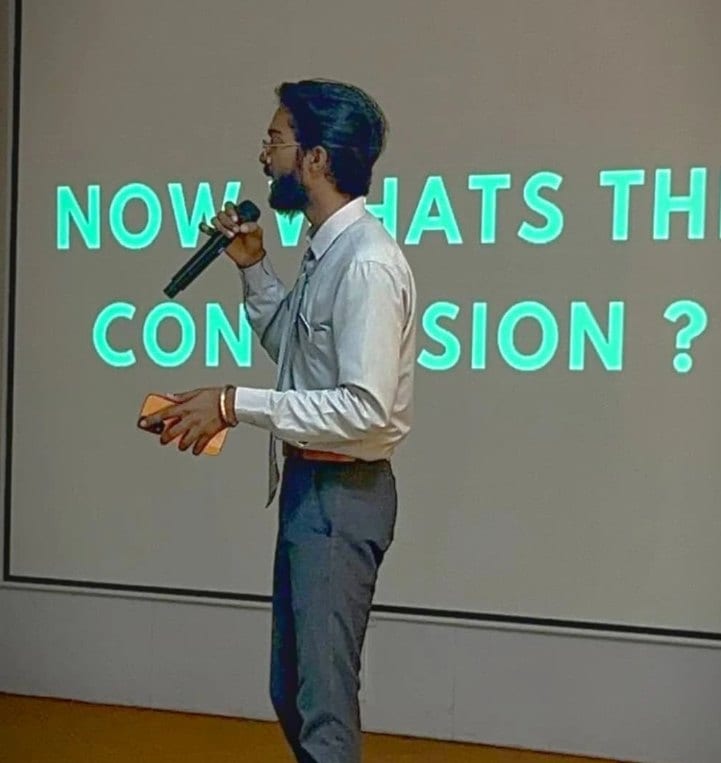
With students
Sessions where this advice gets given in person.

Read next
Roles, paths and the skills behind them.
An engineering team making the AI transition?
I run one-day workshops that take a working service to a grounded, evaluated AI feature.